Vietnamese Latin Alphabet: Why Quốc Ngữ Took Over
The Vietnamese Latin alphabet, called quốc ngữ, began in the 1600s, when missionaries wrote the language in Latin letters to learn it. For centuries before, Vietnamese was written with Chinese characters and a local script called chữ Nôm, and the Latin script, called quốc ngữ, took over only in the early 1900s.
Writing before the alphabet
For more than a thousand years, official writing in Vietnam used Chinese. Government papers, poems and religious books were all written in Chinese characters.
From about the 1100s, writers also used chữ Nôm. It was built from Chinese characters, plus new characters made in Vietnam, so that Vietnamese words could be written down as they were spoken.
Sources: Vietnamese alphabet article, Wikipedia, read 16 November 2026.
The missionaries and their dictionary
From about 1620, Portuguese and Italian Jesuit missionaries began writing Vietnamese in Latin letters. They did it to help themselves learn the language. Francisco de Pina was one of the first.
Alexandre de Rhodes, a Jesuit from Avignon, built on their work. His Vietnamese, Portuguese and Latin dictionary was printed in Rome in 1651 and has about 8,000 Vietnamese entries. It used the new spelling, and it is the reason his name is tied to the alphabet today.
Sources: Vietnamese alphabet and Dictionarium Annamiticum Lusitanum et Latinum articles, Wikipedia, read 16 November 2026.
Two hundred quiet years
For about 200 years, the new script stayed mostly inside the Catholic community. Even there, many religious books were still written in chữ Nôm.
Later missionaries kept improving the spelling. A Vietnamese and Latin dictionary by Jean Louis Taberd, printed in 1838, carried that work forward.
Sources: Dictionarium Annamiticum Lusitanum et Latinum article, Wikipedia, read 16 November 2026.
How quốc ngữ became the national script
The name chữ quốc ngữ, "national language script," was in use by 1867. French rule pushed the script, and in 1910 the colonial government made it official.
Historian Liam Kelley points to a 1906 order by Emperor Thành Thái. It let parents choose whether their children studied in Chinese or in the new script. Writers and teachers from the south also spread it through newspapers and books.
Sources: Vietnamese alphabet article, Wikipedia, read 16 November 2026, citing Liam Kelley, 2016.
How to read the marks on signs and menus
The Vietnamese alphabet has 29 letters. Seven of them carry extra marks: a with a hat (â), a with a cup (ă), e with a hat (ê), o with a hat (ô), o with a hook (ơ), u with a hook (ư), and d with a bar (đ).
Five more marks show the tone, the rise or fall of the voice. They sit above or below a vowel, and one letter can carry two marks at once. Each mark changes the meaning, so the same letters with a different mark can be a different word.
Sources: Vietnamese alphabet article, Wikipedia, read 16 November 2026.
Where a visitor still sees the older scripts
Chinese characters are still used in Vietnam for decoration, history and ceremony, so you may spot them on old buildings and at special events. Chữ Nôm has fallen out of everyday use.
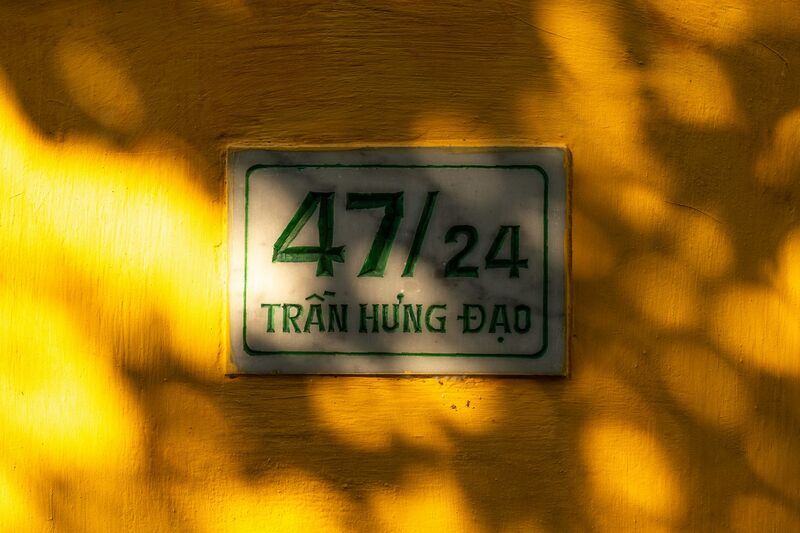
Signs, menus and street names are all in quốc ngữ. If a word looks like Latin letters with extra marks, it is Vietnamese, not French or Portuguese.
Sources: Vietnamese alphabet and Chữ Nôm articles, Wikipedia, read 16 November 2026.
Why some letters sound alike
Most pages explain who made the alphabet but not why its spelling can puzzle a visitor. The spelling rules came from Portuguese, Italian and French habits. Spoken Vietnamese has kept changing since the 1600s, so today different letters or letter pairs can stand for the same sound.
Vietnamese also writes some sounds with letter pairs, such as ch, kh, ng, nh, ph, th and tr, and one group of three, ngh. Learn those pairs and street signs get much easier to sound out.
More language and history guides: is Vietnamese similar to Chinese, ancient Vietnamese coins and Vietnamese traditional dress.
Sources: Vietnamese alphabet article, Wikipedia, read 16 November 2026.
About the original article
Dinh-Hoa Nguyen's "Vietnamese Lexicography," a history of Vietnamese dictionaries, ran in the first Vietnam Journal. We did not draw on its text for this guide. It is in our archive, republished in full with credit.
Sources: Vietnam Journal archive, inventory of the original magazine, read 16 November 2026.
Questions visitors ask
Who created the Vietnamese alphabet?
Jesuit missionaries from Portugal and Italy began writing Vietnamese in Latin letters from about 1620. Francisco de Pina was one of the first. Alexandre de Rhodes built on their work, and his dictionary, printed in Rome in 1651, used the new spelling.
When did quốc ngữ become Vietnam's national script?
French rule pushed the script, and in 1910 the French government made it official. In 1906 Emperor Thành Thái let parents choose if their children studied in Chinese or in the new script.
How many letters are in the Vietnamese alphabet?
It has 29 letters, and seven of them carry extra marks, such as â, ơ and đ. Five more marks show the tone, and a different mark can make the same letters a different word.
What was chữ Nôm?
Chữ Nôm was a script built from Chinese characters plus new ones made in Vietnam, used from about the 1100s. It let writers set down Vietnamese words as they were spoken. It is no longer in everyday use.
Sources
- Wikipedia contributors, Vietnamese alphabet, Wikipedia, read 16 November 2026. Cites Liam Kelley, Emperor Thành Thái's Educational Revolution, 2016.
- Wikipedia contributors, Dictionarium Annamiticum Lusitanum et Latinum, Wikipedia, read 16 November 2026.
- Wikipedia contributors, Chữ Nôm, Wikipedia, read 16 November 2026.
- de Rhodes, Alexandre, Dictionarium Annamiticum Lusitanum et Latinum, Rome, Propaganda Fide, 1651, as described in the record above.