Áo Ngũ Thân to Áo Dài: An Alumni History of Vietnamese Dress
Original title: Vietnamese Traditional Costumes and Fashion
Áo ngũ thân, the five panel dress, is one step in the story this article tells. The Gia Long Alumni Association of Seattle wrote it for a show in 2000. It follows women's dress from the older áo tứ thân to the modern áo dài, and it is a first hand record of how one school community told that history.
Key facts
- Author
- Gia Long Alumni Association of Seattle
- Credit
- Written for the evening program The Evolution of the Ao Dai Through Many Eras, 2000, and adapted for readers
- First published
- Vietnam Journal, January 2003 issue
- Type
- Research paper
- What it covers
- Áo tứ thân, áo ngũ thân, northern hair styles, the Cát Tường style, southern and royal áo dài, raglan and collarless styles, áo bà ba and nón lá
The original article
Below is the full text as Vietnam Journal printed it, with its credit. We have not changed the authors' words.
Vietnamese Traditional Costumes and Fashion
By Gia Long Alumni Association of Seattle
First published in Vietnam Journal, January 2003 issue
An image appeared here in the original.
This section will be confined to the traditional costumes of women and women's fashion. The Vietnamese have long been proud of our traditional costume for women: the ao dai, which can be translated as long dress. Why are we so fond of this garment? This question can be answered with a quote from the writer Vo Phien: The ao dai both follows the beautiful lines of the body and flatters it by lending it a sense of fluid movement it does not have. There, the eye only sees the wind, the fluid grace, and the blithe fluttering. The ao dai is very simple (pronounced ow-yigh). It has long sleeves, a high mandarin collar, with hidden buttons from the collar down in front of the shoulder, underneath the arm, and along the side down to the waist. At the waist, the dress slits into a front and back flap. The flaps are the same length, down to the knees or longer. Ao dai can be worn with loose-fitting black or white pants. But that is only the basic ao dai because it has been and will always be continually changed to suit the taste of its wearer. Following is the history of the ao dai written and researched by the Gia Long Alumni Association of Seattle (Gia Long was a prominent all-girls high school in South Vietnam). It was compiled for an evening program called The Evolution of the Ao Dai Through Many Eras in 2000. It has been changed to make it suitable for readers instead of for a live audience.
History of the Ao Dai
An image appeared here in the original.
Even now, no one is certain of the true origin of the ao dai. According to tradition, the Trung sisters wore two-flapped ao dai on the battlefield, mounted on the backs of elephants, when they fought the Chinese invaders. Also according to tradition, Vietnamese women started wearing the ao tu than instead of the two-flapped ao dai to show their respect and admiration for the Trung sisters (In Vietnamese custom, one often avoids having similar accouterments or names as someone one respects). In the 18th century, during the rule of the Nguyen lords in the South, Lord Nguyen Phuc Khoat, had the people of his dominions dress differently than the people of the North in order to develop a sense of independence (the North, where women wore ao tu than, was under the rule of the Trinh lords). Women were to wear a dress with a high collar that had the front and back of the dress sewn together with seams running down from under the arms. So the ao dai was born, its design a compromise between its origins in the North and its reintroduction in the South.
Ao Tu Than (Four-flapped Dress)
An image appeared here in the original.
Before the ao dai was considered our traditional costume, we had the ao tu than, which translates as the four-flapped dress. The dress is long-sleeved and usually dark brown, with two front and two back flaps, or strips of fabric. The two back flaps are sewn together with a seam running down the spine, called the dress's spine. The two flaps in front are not sewn together but are attached to the back flaps as the well as the sleeves. These two front flaps are knotted in front of the waist. Two blue or light green sashes are wrapped around behind the waist over the back flaps like a belt and tied together with the two front flaps. Together, the front flaps and the sashes dangle like ribbons and move with the rhythm of the woman's steps. Beneath the dress is a worn a white or bright pink yem, a diamond shaped piece of fabric that covers the chest and has straps from the right and left corners to tie be tied around the back and straps at the collar to secure it around the neck. The bottom corner of the yem is tucked under a long black skirt worn beneath the dress. From the 17th through the 19th century, Vietnamese women wore ao tu than with skirts to differentiate themselves from men, who wore a similar costume with pants. In 1928, during the Nguyen dynasty, Emperor Minh Mang ordered women to wear pants instead of skirts. However, until the 10th century, the familiar costume of young women of the Northern countryside remained an ao tu than and a skirt of rough cloth.
Ao Ngu Than (Five-flapped Dress)
An image appeared here in the original.
During the reign of Gia Long (1802-1819), the ao tu than was transformed into the ao ngu than, which can be translated as the five-flapped dress. The ao ngu than's design is similar to the ao tu than's. The newer version has both the two back flaps and the two front flaps sewn together. The four connected flaps are called vat ca (main flaps), and the tiny flap inside attached to the front vat ca is called a vat con (baby flap). Also, the ao ngu than has buttons; the wearer can button it in the style of the modern ao dai or only button the lower buttons, revealing the yem and the vat con underneath. The ao ngu than is worn with loose black pants, often made of the shiny linh cloth. If the ao tu than is the common ordinary dress for everyday work, the ao ngu than is the formal wear for holidays, festivals and marriages. During such occasions, women often wore a non quai thao, which translates as a tasseled-strap hat. It is a large, circular flat hat, used to block the sun. It has a cord-like strap to keep it secure on the head with large tassels at the end.
Traditional Women's Hairstyles of the North
An image appeared here in the original.
Aside from the ao tu than and ao ngu than, the traditional look of Northern girls included a khan dong and a khan mo qua. The khan dong is a black piece of fabric wrapped around a girl's long hair so that it forms a tube around the hair. The fabric-entubed hair is wrapped around the crown of the head. Usually, the girl's hair is a little bit longer than the khan dong, forming a skinny, wispy ponytail sticking out of the khan dong. This ponytail is left dangling down from the khan dong on one side of the head. The Vietnamese call this hairstyle toc duoi ga because the ponytail resembles a rooster's tail (toc duoi ga means chicken- or rooster-tailed hair).
An image appeared here in the original.
For formal occasions, Vietnamese girls often used khan dong made of black velvet. Instead of the rooster-tailed hair, they would pin the extra hair down and cover their heads with a khan mo qua, meaning crow's beak kerchief.
An image appeared here in the original.
A khan mo qua is a black, square piece of heavy fabric. It is folded in half into a triangle and worn over the khan dong to cover the hair. The long side of the triangle is placed above the forehead while the two corner of the long side are tied at the nape of the neck (like the American bandana and kerchiefs). Because the khan mo qua is made of heavy, stiff fabric, the long side the of the triangle, or the folded edge, sticks out in front of the forehead in a point, sharp as a crow's beak.
Ao Dai Cat Tuong (Cat Tuong-styled Ao Dai)
An image appeared here in the original.
The whole of Vietnam became a French colony with the Paternotre Treaty in 1884. Since then, Western culture has become increasingly influential in Vietnam. In the late 1920s, the artist Nguyen Cat Tuong (also known as Lemur) of the group that published the Ngay Nay magazine designed the new Cat Tuong style of the ao dai, sending shock waves through all classes of Vietnamese women. This was a new French-styled dress worn with pants. It only had two flaps, with puffed sleeves and seams along the shoulders instead of the spine. The flaps and sleeves were trimmed with the same fabric. The collar was trimmed with lace or ruffles. It had buttons starting at the collar, running down in front of the shoulders to under the arms, then straight down to the waist. This new style was too bold, and not many women followed it. Only the most thoroughly modern young women dared to wear it. They often wore this very Western style dress with high-heeled shoes and a neckerchief tied loosely around the neck, accessorizing with a purse and a parasol. Also during this time, it was the new fashion to have white teeth, more appropriate to the modern times. Before, young women of the North traditionally dyed their teeth black.
Ao Dai Mien Nam (Southern Ao Dai)
An image appeared here in the original.
Ao dai in the South during the 1930s and 1940s was loose fitting and made of a heavier fabric, such a brocaded woven silk or velvet, and worn with white or black pants. Southern women often wore their hair in a bun at the nape of the neck. The prosperity of the South showed through the jewelry typically worn by Southern girls: engraved torques, gold necklaces, and jade bracelets.
Ao Menh Phu (Ao Dai Hoang Hau), (Royal Ao Dai)
An image appeared here in the original.
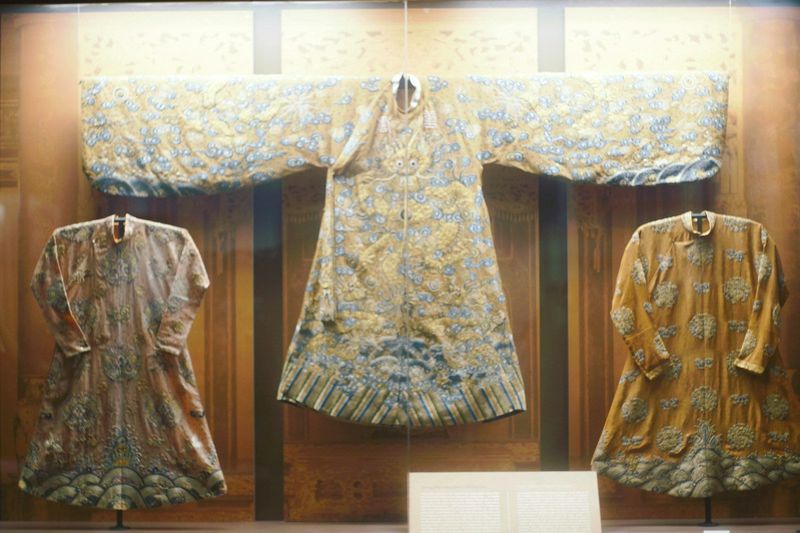
Most elegant and aristocratic of all are the royal ladies of the Nguyen court with their ao menh phu. This ao dai is made of brocaded, woven silk. It is worn under a long cardigan-like robe. The robe is open from the collar down and made of the same material and with a similar pattern as the dress. With the ao menh phu, the royal ladies often wore a khan dong vanh, a fabric crown-like accessory made of starched brocaded woven silk. It is worn on the head and looks rather like a wide headband. This crown is also called a khan hoang hau (queen's kerchief or queen's scarf). This style of the royal ladies of Hue, the capital of Vietnam under the Nguyen dynasty, has become the traditional dress for brides during the marriage ceremony, when the bride becomes of the queen of one man's heart.
Raglan Ao Dai and Bias-cut Pants
An image appeared here in the original.
In the early 1960s, the fashion designer Dung (pronounced Yung) in Dakao, Saigon, created a new style of ao dai: an ao dai with raglan sleeves worn with quan xeo, or bias-cut pants. Because the sleeves are attached at about a forty-five degree angle to the dress, this style avoids the wrinkles under the arms and around the shoulders of earlier styles. The pants are cut at a bias from soft, flowy material and fitted closely at the hips and loosely at the ankles, giving the wearer a graceful walk, her sandaled feet half hidden in the billowy folds of her pants.
Collarless Ao Dai
An image appeared here in the original.
At the same time as the raglan ao dai, the collarless ao dai also appeared (instead of the traditional high mandarin collar). This trend was started by Madame Nhu, a political figure of the 1950s and 1960s. She often wore boatnecked ao dai. This style gave rise to other collarless styles such as the square neck, the sweetheart neckline, and many others, showcasing the beauty of a slender neck and a white throat, which is especially captivating when the woman wears her hair up elegantly off the neck.
A Few Other Styles
An image appeared here in the original.
In the early 1970s, when Vietnamese women were more or less content with the look of the raglan-sleeved ao dai with narrow flaps and a collarless cut, a number of Saigon designers continued to find ways to improve the quality of the ao dai with all sorts of fabric: Ha Dong silk, soft domestically-produced fabric, Thai silk, muslin...
An image appeared here in the original.
Along with a number of artists, they introduced dresses with hand-drawn desgins, from modern geometric designs for young ladies to more conservative flower and cloud designs for more mature women. Never before had the flaps of the ao dai been so vivid, so elegant! Following the changing fashion, the flaps have been shortened and lengthened, the collar raised and lowered, the pants made black or white or of the same color as the dress and even decorated with the same designs... Yet these styles, which have become popular everywhere there are Vietnamese women, are still the raglan-sleeved ao dai with bias cut pants. Our national costume, the ao dai, has not only been popularized everywhere in Vietnam but it has also gained admiration abroad: the blue ao dai uniforms of Air VietNam stewardesses; the fluttering ao dai that awaited the audience on the stage of the International Fair in Osaka, Japan, in 1970; the ao dai gracing with its subtle presence the holidays and festivals of Vietnamese refugees on all five continents after 1975.
An image appeared here in the original.
Everywhere it has been, the ao dai has been admired and praised. (Here ends the history of the ao dai as prepared by the Gia Long Alumni Association of Seattle.)
Ao Ba Ba (Ao Canh)
An image appeared here in the original.
Not as famous as the ao dai but still a traditional costume is the ao ba ba. This shirt is made of soft fabric with long sleeves and a round or sweetheart neckline. It has a row of buttons down the center of the front of the shirt. It is slit from the waist down, with flaps extending just below the hips. It is usually worn with black pants. In the Southern countryside, people often use khan ran (striped scarf) - a narrow white scarf of rough material with red or blue checks - to wear around the neck or wrap around the crown of the head. It is used to wipe away sweat and to keep off the sun.
Non La (Leaf Hat)
An image appeared here in the original.
Non La is used in all three regions, North, Central and South. It is a conical shaped hat made of woven, dried leaves. It is used to shade the head and face from the sun when going outside. The typical image of rural Vietnam is a handful of farmers wearing non la planting rice in the fields.
The non la also has a few different styles such as: Non bai tho (poem hat) originated in Hue. It has, between the layers of woven leaves, a few lines of poetry or carefully cut pictures. When the sun shines on a non bai tho, the lines of poetry or the picture appears as dark silhouettes through the thin layers of the hat that is illuminated by the sun.
Non Go Gang takes its name from the village where it is produced, Go Gang. The inside of the hat is embroidered with brightly colored thread.
An image appeared here in the original.
Today, of all the traditional costumes mentioned above, only the ao dai and the ao ba ba are still worn. With the influence of Western culture, Vietnamese men now wear only Western clothes. In the urban areas, men no longer wear non la, and women wear them only with ao dai or ao ba ba. Except for rural areas, one no longer sees khan ran in common usage. Only elderly women still twist and wrap their hair around the crown of their heads in the traditional Northern style. Since the time of French colonization, the Vietnamese have been increasingly used to seeing and wearing European clothes such as slacks, button-up shirts, vests, jeans, T-shirts, etc... yet our traditional costumes have not been forgotten because of that. At every wedding, every holiday celebration, at fashion shows, the ao dai still appears. In the very gracefulness of the modern ao dai are the hidden traces of that traditional beauty of ao tu than and ao ngu than of our antique past - a beauty that has given the ao dai a singularly honored place in Vietnamese women's fashion.
We would like to thank the Gia Long Alumni Association of Seattle for their generosity in letting us use the material they compiled for the evening program The Evolution of the Ao Dai Through Many Eras of 2000. Their material was based on sources by Tran Thi Lai Hong, Nhu Ngo, TTVH, and Nguyen Huynh.
The original page, Vietnam Journal January 2003, as kept by the Internet Archive: http://www.vietnamjournal.org/article.php?sid=138
How to use this history
Read it as a timeline. The four panel áo tứ thân comes first, then the five panel áo ngũ thân under Gia Long. After that come the Cát Tường style of the late 1920s and the Saigon raglan cut of the early 1960s.
This is a community history, not a museum catalog. It does not tie each claim to its own source, so check a date against a second source before you quote it.
The photos in the original did not survive in the archived copy. Only the text is left, so the page shows a note where each picture once was.
Source: the article above, by the Gia Long Alumni Association of Seattle.
Context today
A few dates in the article need a note. It gives 1928 as the year Emperor Minh Mạng made women switch from skirts to pants. Minh Mạng ruled from 1820 to 1841, so the year was most likely 1828.
The article does not date the dress order of Lord Nguyễn Phúc Khoát. Sources today place it in 1744, when he told his court in the south to dress apart from the north.
The designer the article calls Lemur is Nguyễn Cát Tường, and Le Mur was the name of his shop. Today the word áo dài most often means his close fitting design.
The áo dài is still part of daily life. People wear it for weddings and Tết, and many high school girls in the south wear it as a uniform. To see older dress, visit the Vietnamese Women's Museum on Lý Thường Kiệt Street in Hà Nội, open every day from 8:00 to 17:00.
For what each garment is and where to have one made, read our guide to Vietnamese traditional dress.
Sources: Wikipedia, Áo dài and Minh Mạng, read 17 November 2026; Vietnamese Women's Museum official site, read 17 November 2026.
Questions readers ask
What is the áo ngũ thân?
It is a five panel dress that grew out of the four panel áo tứ thân. Four main panels are sewn together, and a small fifth panel sits inside the front. The article dates it to the reign of Gia Long, from 1802 to 1819.
Who wrote this history?
The Gia Long Alumni Association of Seattle wrote it. Gia Long was a well known girls' high school in South Vietnam. Vietnam Journal printed the history in January 2003.
Who designed the modern áo dài?
The article credits the artist Nguyễn Cát Tường with a new style in the late 1920s. Sources today date his design to 1930 and say Le Mur was the name of his shop.
Which of these clothes do people still wear?
When the article was written, it named the áo bà ba and the áo dài as the two styles people still wore. The áo dài is still worn today for weddings and Tết, and as a school uniform in the south.
Sources
- Wikipedia contributors, Áo dài, Wikipedia, read 17 November 2026
- Wikipedia contributors, Minh Mạng, Wikipedia, read 17 November 2026
- Vietnamese Women's Museum, official site, address and opening hours, read 17 November 2026
More from January 2003 issue.