Đông Sơn Bronze Drums and Where to See Them
Đông Sơn bronze drums are large drums made by the Đông Sơn culture of northern Vietnam's Red River Delta, from about 600 BCE to the 200s CE. The drums were cast in bronze and covered in scenes of boats, birds, houses and people. In Hà Nội, a visitor can see them at the Vietnam National Museum of History.
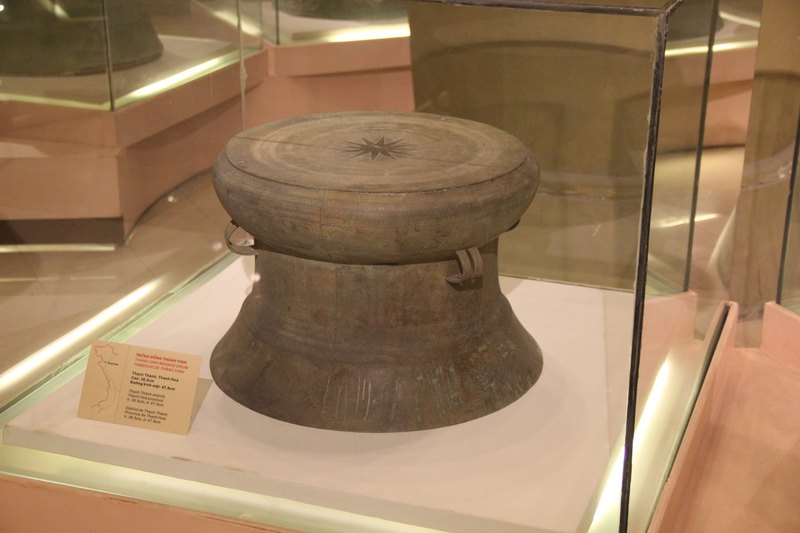
What a Đông Sơn drum is
The drums were made with the lost wax method. A model was made in wax, covered in clay, and then the wax was melted out and bronze poured in. Some drums stand up to a meter tall and weigh up to 100 kilograms.
Each drum has three parts: the top, called the head, the body and the foot. Scholars call this kind of drum Heger Type I, after a man who sorted 165 drums into four types in 1902.
Sources: Đông Sơn drum article, Wikipedia, read 16 November 2026, citing Charles Higham, 1996.
What the drums were used for
The drums were played as instruments and also treated as holy objects. They were used at festivals, in prayers for rain and a good harvest, and at weddings and funerals.
They also showed the power of a local leader, and some were buried with the dead. Some temples in Vietnam later worshipped drums that had been dug up.
Sources: Đông Sơn drum article, Wikipedia, read 16 November 2026.
What the scenes show
The decoration mixes rings of patterns with pictures of daily life. You can find houses on stilts, people dancing, people pounding rice, men playing drums and boats with rowers.
Birds and animals fill the outer rings. A bird known as the Lạc bird is one of the figures that comes back again and again. The boats hint at how much trade mattered to the people who made the drums.
Sources: Đông Sơn drum article, Wikipedia, read 16 November 2026.
Where the drums were found
More than 200 drums of this type have been found, from Vietnam and southern China as far as eastern Indonesia. Some even reached New Guinea, which shows how far they traveled by trade.
The culture takes its name from Đông Sơn village in Thanh Hóa province, where drums and other bronzes were dug up in 1924.
Sources: Đông Sơn drum article, Wikipedia, read 16 November 2026.
The Ngọc Lũ drum
The most famous drum was found by chance in 1893 by workers building a dike in Hà Nam province, southeast of Hà Nội. It is named after the village where it was found.
Its top is richly decorated and well kept. In 2012 it was the first object on Vietnam's first list of 30 national treasures.
Sources: Ngọc Lũ drum article, Wikipedia, read 16 November 2026.
Seeing the drums in Hà Nội
The Vietnam National Museum of History is at 1 Tràng Tiền Street, behind the Hà Nội Opera House. Its collection covers the Đông Sơn culture, and its site lists bronze drums such as the Sao Vàng drum and the Phú Phương I drum.
The museum's site gives opening times of 8 am to 12 pm and 1:30 pm to 5 pm, and says it is closed on Mondays. Check the site before you go, since times can change.
Sources: Vietnam National Museum of History, official site, and Vietnam National Museum of History article, Wikipedia, both read 16 November 2026.
A drum that shows drums
One detail most pages miss: the Ngọc Lũ drum pictures itself. Its inner ring shows people at a ceremony that seems to use drums like this one, along with other instruments and men in tall feathered headdresses. So when you look at a drum's top, you may be looking at a picture of how it was once played.
More guides: ancient Vietnamese coins, why Vietnamese uses the Latin alphabet and the first Vietnam Journal's archive.
Sources: Ngọc Lũ drum article, Wikipedia, read 16 November 2026.
About the original article
Xiaorong Han's essay "The Present Echoes of the Ancient Bronze Drum: Nationalism and Archeology in Modern Vietnam and China" appeared in the first Vietnam Journal. It looks at how the drums are used in national stories in both countries. This guide takes a visitor's angle and uses none of its wording; the full essay is in our archive.
Sources: Vietnam Journal archive, inventory of the original magazine, read 16 November 2026.
Questions visitors ask
How old are the Đông Sơn drums?
They were made by the Đông Sơn culture of northern Vietnam's Red River Delta, from about 600 BCE to the 200s CE. The culture is named after Đông Sơn village in Thanh Hóa province, where drums and other bronzes were dug up in 1924.
Where can I see a Đông Sơn drum in Hà Nội?
The Vietnam National Museum of History at 1 Tràng Tiền Street, behind the Hà Nội Opera House, covers the Đông Sơn culture. Its site gives opening times of 8 am to 12 pm and 1:30 pm to 5 pm and says it is closed on Mondays. Check the site before you go, since times can change.
What were the bronze drums used for?
They were played as instruments and treated as holy objects at festivals, in prayers for rain and a good harvest, and at weddings and funerals. They also showed the power of a local leader, and some were buried with the dead.
What is the Ngọc Lũ drum?
It is the most famous drum, found by chance in 1893 by workers building a dike in Hà Nam province. In 2012 it was the first object on Vietnam's first list of 30 national treasures.
Sources
- Wikipedia contributors, Đông Sơn drum, Wikipedia, read 16 November 2026. Cites Charles Higham, The Bronze Age of Southeast Asia, Cambridge University Press, 1996.
- Wikipedia contributors, Ngọc Lũ drum, Wikipedia, read 16 November 2026.
- Vietnam National Museum of History, official site, collection highlights, address and opening hours, read 16 November 2026.
- Wikipedia contributors, Vietnam National Museum of History, Wikipedia, read 16 November 2026.