Temple of Literature Hanoi: Vietnam's First College
Temple of Literature Hanoi, called Văn Miếu in Vietnamese, is a temple to Confucius that also held the country's first royal college. It was founded in 1070. For about seven hundred years, the kingdom's brightest young men studied here, and the names of those who passed the top exams were cut into stone.
What the Temple of Literature is
King Lý Thánh Tông founded the temple in 1070 to honor Confucius and his followers. Six years later, in 1076, a royal college called Quốc Tử Giám opened on the same grounds. It is often called Vietnam's first national university.
The college worked until 1779. After the Nguyễn kings moved the capital to Huế in 1802, they opened a new college there, and the Hà Nội school faded. The temple itself stayed open.
The site covers more than 54,000 square meters south of the old royal citadel of Thăng Long. Its picture is on the 100,000 đồng banknote, so many Vietnamese carry it in their wallet.
Sources: Temple of Literature article, Wikipedia, read 17 November 2026.
The five courtyards, gate by gate
The temple is a long walled ground split into five courtyards, one after another. You walk from the front gate on Quốc Tử Giám Street toward the back, moving from the outside world to the place of learning.
- First and second courtyards. Gardens, lawns and old trees.
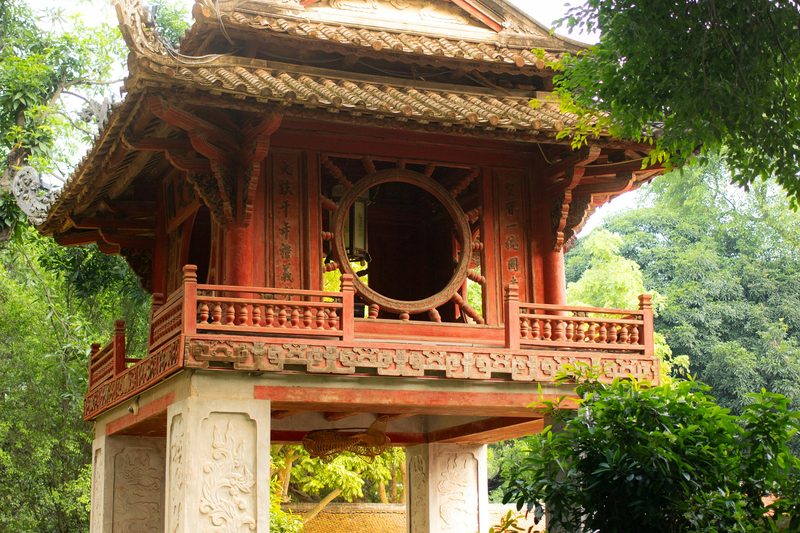
- Khuê Văn Các. A small two story pavilion on four brick pillars, built in 1805. Its name means the Pavilion of the Constellation of Literature. It is now a symbol of Hà Nội.
- Third courtyard. A square pond called the Well of Heavenly Clarity, with the stone stelae lined up on both sides.
- Fourth courtyard. The main temple halls, with altars to Confucius and his followers.
- Fifth courtyard. The site of the old college. It was destroyed in fighting in 1946 and rebuilt in 2000.
Sources: Temple of Literature article, Wikipedia, read 17 November 2026.
What the official exhibits cover
Vietnam ranks the temple as a Special National Historical Site, its top grade for a historic place. A centre set up by the Hà Nội People's Committee in 2009 runs it.
The centre keeps two lasting exhibits. One, called "Quốc Tử Giám, The First National University", tells the story of the college. The other, "Stone Steles of Achievement", sits in the garden of the doctors' stelae.
Most accounts give 1076 for the college, but some say a king ordered it in 1077. The exact year is not settled.
Sources: Văn Miếu Quốc Tử Giám Centre, official visitor site, and Temple of Literature article, Wikipedia, both read 17 November 2026.
The 82 turtle stelae
The stelae are the heart of the visit. Each is a stone tablet resting on the back of a carved stone turtle.
King Lê Thánh Tông began putting them up in 1484. In all, 116 were made, and 82 survive.
They record 82 royal exams held from 1442 to 1779: 81 under the Lê kings and one under the Mạc. Together they name 1,307 men who earned the top degree.
The exams came about once every three years. You can still read the names today.
In 2011, UNESCO added the stelae to its Memory of the World Register, its list of records that matter to all people.
Students once rubbed the turtles' heads for luck. So many did it that the stone wore down, and a fence now keeps visitors back.
Sources: Temple of Literature article, Wikipedia, read 17 November 2026.
Tết calligraphy and repairs
Before Tết, the Lunar New Year, calligraphers set up outside the walls. They brush New Year wishes in the old Chinese script onto red sheets that families take home and hang up. It is one of the few places in Hà Nội where this old trade is still easy to watch.
The temple has been damaged and repaired many times. The French registered it as a historic monument in 1906.
Between 1945 and 1954, part of the ground was taken down to grow a nearby hospital. Big repairs took place in 1920, 1947, 1954 and 2000.
Sources: Temple of Literature article, Wikipedia, read 17 November 2026.
Restoration timeline
This table puts the founding, the losses and the repairs in date order.
| Year | What happened |
|---|---|
| 1070 | Temple founded for Confucius |
| 1076 | Royal college opens on the grounds |
| 1484 | First stone stelae put up |
| 1779 | Last exam recorded on a stele |
| 1805 | Khuê Văn Các built |
| 1906 | Registered as a historic monument |
| 1945 to 1954 | Part of the ground cleared for a hospital |
| 1946 | Fifth courtyard destroyed |
| 2000 | Fifth courtyard rebuilt |
| 2011 | Stelae join UNESCO's Memory of the World Register |
Sources: Temple of Literature article, Wikipedia, read 17 November 2026.
Visiting: where, when and what it costs
The main entrance is at No. 58 Quốc Tử Giám Street.
You leave by Văn Miếu Street, at numbers 19 to 21, or by the path to Giám Garden across from No. 40 Tôn Đức Thắng Street.
The visitor details below come from the centre's own website, checked on 17 November 2026:
- Hours: daily, 8:00 to 17:00. An evening program runs from 18:00 to 22:00 on Wednesday, Saturday and Sunday, with its own ticket.
- Standard ticket: 70,000 đồng for adults.
- Half price, 35,000 đồng: students at Vietnamese schools with a student card, people aged 60 and over with an ID card, and people with severe disabilities.
- Free: children under 16.
Hours and prices can change, so confirm them on the centre's website on the day.
The stelae are carved in Chinese characters, the script scholars used before the modern alphabet. Our guides to Sino-Vietnamese words and the Vietnamese Latin alphabet explain how the language moved from one to the other.
Hoa Lo Prison is also in central Hà Nội, and our places section lists more sites to see.
Sources: Văn Miếu Quốc Tử Giám Centre, official visitor site, and Temple of Literature article, Wikipedia, both read 17 November 2026.
Questions visitors ask
How old is the Temple of Literature in Hanoi?
It was founded in 1070 under King Lý Thánh Tông. The royal college on the grounds followed in 1076, which makes the site more than 950 years old.
What are the turtle stelae?
They are stone tablets set on carved stone turtles. Each one lists the men who passed a royal exam. Of 116 put up, 82 remain, covering exams from 1442 to 1779.
Can you touch the turtles' heads?
No. Visitors used to rub the heads for luck before exams, and a fence now keeps people back to protect the stone.
Is there an evening visit?
Yes. On 17 November 2026 the centre's website showed an evening program from 18:00 to 22:00. It runs on Wednesday, Saturday and Sunday, with its own ticket.
Sources
- Wikipedia contributors, Temple of Literature, Hanoi, Wikipedia, read 17 November 2026.
- Văn Miếu Quốc Tử Giám Centre, official visitor site, hours, tickets and address, read 17 November 2026.